An unexpected return to academia
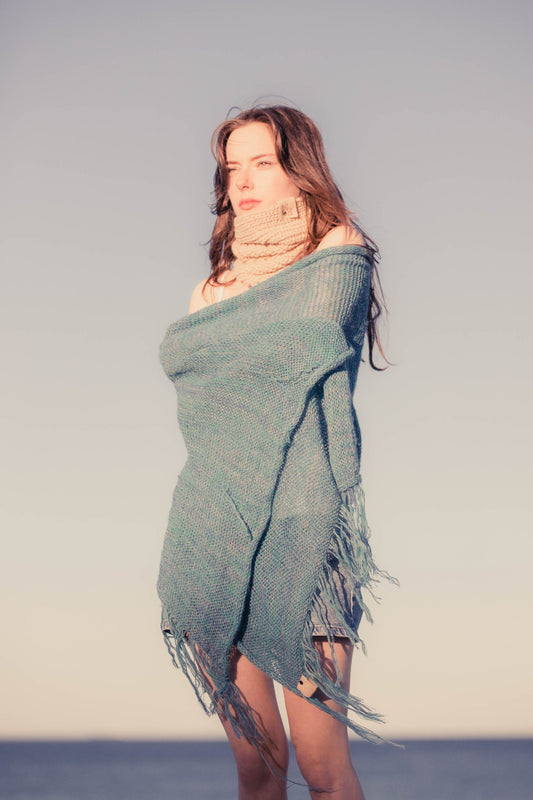
Angelina Russophoto: Rosina Possingham
Have you ever been sure of your direction, only to find the ground move under you at the moment it most needed to?
That's more or less what has happened to me this month. On 14 July I took up a role as Professor of Fashion and Advanced Manufacturing at the Flinders Factory of the Future at Tonsley. For those of you who know me well, I had little faith that I would ever work in academia, or on my own research, again. I've spent the last 4 years building Fleurieu Made and developing the FM Circular Fashion IQ Index while working, ostensibly, in aged care.
What changed was policy. In March, the Australian Fashion Council and R.M.Williams launched the National Manufacturing Strategy for Australian Fashion and Textiles 2026 to 2036. Around the same time, the Centre of Excellence in Sustainable Fashion and Textiles published its workforce blueprint, which names twenty new textile, clothing and footwear roles for which Australia currently has no curriculum at all, more than a third of them advanced-manufacturing roles (Centre of Excellence in Sustainable Fashion and Textiles, 2026). Alongside those two documents sit the Malinauskas Government's Advanced Manufacturing Strategy, and further funding committed federally to the Factory of the Future itself.
Taken together, these instruments make sovereign textile manufacturing fundable for the first time in a generation. Importantly, as I was preparing for interview, these developments gave me a way to shape the research and practice behind the 2025 Green Industries SA Women in Circular Economy Leadership Fellowship for an institution, in the form of a capability pathway that Flinders has since backed.
That backing matters because of what was lost. Some of you might remember that Australia once made world-leading knitwear, and South Australia holds a specific case in the label, Spinelli, Knitwear of Distinction (History Trust of South Australia, n.d.). Elena and Sante Spinelli migrated from Italy to Adelaide in 1950, and Elena, who had knitted by machine since she was a teenager, began production on a single machine set up in a friend's laundry. Spinelli Knitting Pty Ltd was established in 1960, moved to a factory at Kensington, employed more than a hundred people, and traded nationally. Production was also distributed to home-based machine knitters across Adelaide's Italian migrant community, women who had learned the craft in Italy and who worked to the label's specification on domestic machines in their own homes.
The firm closed in 2006 after more than forty years. The closure is attributed to the firm no longer being able to obtain the quality of yarn its designs required or the skilled labour its production depended on. Both of those conditions were made elsewhere: the removal of import tariffs through the 1980s, the growth of fast fashion through the two decades that followed, and the thinning of specialist supply chains and skilled workforce as the sector around it contracted. A firm can be well run and still be closed by the conditions it operates within. Knitwear has not been taught in South Australia for a generation, and the resulting skills gap makes filling newly created roles at businesses such as Silver Fleece and Kangaroo Island Wool close to impossible.
Years ago, before I left full-time academia, I worked to develop a pathway digital fabrication lab, Mobile Makers. That initiative never left me, because I'd seen the value of the lab to both students and industry. When I was preparing the presentation for the interview at the Factory of the Future, I revisited the belief that we could build a pathway studio, this time bringing together digital knit, an area I've worked in for fifteen years, and a pathway to skills development, all under the framework of advanced manufacturing.
That belief now has an academic home. The ground for localised advanced manufacturing in fashion and textiles, as a business rather than as a craft revival, is currently unclaimed. The research programme we are developing explores it through four streams: the economics of smart factory adoption in small and medium supply chains; productivity and intellectual property integrity in circular supply chains; curriculum design for those twenty unaddressed roles; and the policy instruments through which fibre-to-fibre reconstruction can be supported. The first piece of physical capability is the Pathway Digital Knit Studio, a shared-access teaching and research testbed carrying participants from hand and domestic machines through to digital knitting. It opens for workshops in October, with the digital machines in production from March 2027.
Alongside this, the research management role I'd only just started at the University of Melbourne, after two and a half years of preparation, continues. As I settle into the Flinders role the shape of that commitment will change over the coming months, though not before I've worked out how to bring the two bodies of work together.
So I'll keep writing about circularity, sovereign manufacturing, verification and all things design. The FM Circular Fashion IQ Index continues to be tested with brands, and I'm looking forward to sharing those developments alongside the activities of the Pathway Digital Knit Studio and the Bridging Worlds project over the coming months. Do contact me if you'd like to know more.
Angelina Russo, PhD, MBAHEM is the Founder, Fleurieu Made, a circular knitwear label using vintage yarns, and the FM Circular Fashion IQ Index, a procurement verification platform for circular fashion practice. She is a 2025 Green Industries SA Women in Circular Economy Leadership Fellow, currently undertaking field research at circular textile hubs. Her fellowship research is examining the manufacturing and infrastructure models that support circular textile production at scale. Adelaide University 2025 Venture Catalyst Alumna. She is Professor of Fashion and Advanced Manufacturing at the Flinders University Factory of the Future.
Contact angelina@fleurieumade.com / www.fleurieumade.com
References
Australian Fashion Council. (2026). National manufacturing strategy for Australian fashion and textiles 2026–2036. Australian Fashion Council, in partnership with R.M.Williams.
Centre of Excellence in Sustainable Fashion and Textiles. (2026). WORK: Fashion and sustainability jobs of the future. University of Technology Sydney and TAFE NSW.
History Trust of South Australia. (n.d.). Spinelli Knitting [Collection records]. History Trust of South Australia.