Why Shein outscored Myer: sustainability claims need validating, not stating
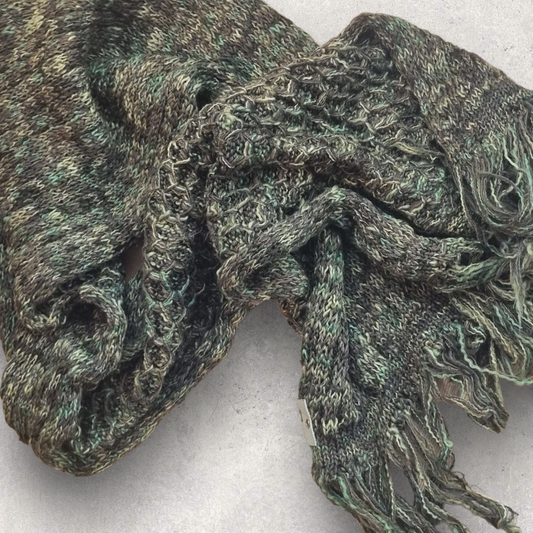
Angelina RussoImage: Brand new Shein sweaters in a regional second hand shop - unworn with tags. Photo by Russo
What does it mean when an industry writes the policy but can't show the practice?
That's the question Baptist World Aid's eleventh Ethical Fashion Report puts to Australian fashion this week. The report scores 138 companies, representing 543 brands, across 48 measures: governance, supply-chain tracing, supplier relationships, worker empowerment and environmental sustainability.
The average brand scored 31.5 out of 100, a 0.2 per cent improvement on 2024 (Baptist World Aid, 2026; McLeod, 2026; Walker, 2026). Yet 93 per cent of companies now hold policies on workers' rights and sustainability. Only 7 per cent earned a perfect score on responsible purchasing practices, the measure that asks whether a brand's own ordering behaviour lets its suppliers act ethically. And, as the report's ethical fashion lead Katherine Halliday puts it, almost no garment worker in these supply chains earns a living wage¹. Only 13 per cent of companies could show evidence of paying one to any worker at all (McLeod, 2026).
So the headline isn't that brands lack ambition, it's that the distance between a stated policy and a validated one has stopped closing. Importantly, that distance is structural rather than moral, and it's worth understanding why before we reach for the usual remedies.
Where the recycling sceptics are half right
If the gap is structural, the first thing to check is whether we've been measuring the wrong things. RMIT's Harriette Richards suggests we have. She argues that the sector's focus on waste, circularity and recycling may be "slightly misplaced", given that textile recycling remains nascent and may never deliver what's claimed for it (Walker, 2026). On recycling, she's right. Fibre-to-fibre recycling² handles a small fraction of global textile waste, and the report itself notes that growth in fibre production, especially petroleum-based synthetics, has outpaced any gains from the 38 per cent of brands now using preferred fibres.
But recycling isn't circularity. It's the last and weakest loop in a circular economy³ whose first loops are durability, repair, reuse and remanufacture (Ellen MacArthur Foundation, 2017). Richards' own observations point there: a recycled or natural fibre says nothing about whether a garment was built to last, and a brand's deadline can push an offshore supplier into subcontracting under conditions the brand's code of conduct forbids. Both of those are facts about a specific garment: how it was constructed, who made it, under what order terms. Both can be validated and neither shows up in a corporate policy statement.
That's the distinction I'd draw. The circularity critique is fair when circularity means a recycling bin at the end of the chain but it misses when circularity means evidence carried by the product itself.
What a score of zero measures
That distinction, between a policy and the evidence behind it, is also the key to the result that made the headlines. The Guardian led with Shein which scored 28, outperforming Myer at 20, Boardriders and Bec and Bridge at 3, 2XU at 2, Seafolly at 1, and Ghanda, Windsor Smith and Temu at 0 (McLeod, 2026).
Read as a verdict on ethics, that's absurd: a department store with thousands of Australian staff and a published code of conduct is not plainly worse than an ultra-fast-fashion platform selling into the world's highest per-capita consumer of textiles, a country that sends more than 200,000 tonnes of clothing to landfill each year. Read as a verdict on evidence, it's exact.
Shein engaged with the researchers and supplied additional information. Myer, Ghanda, Windsor Smith, Boardriders, Seafolly, 2XU and Bec and Bridge did not, and were scored on public information alone, which the report acknowledges tends to produce a lower result. Across the whole cohort, 58 per cent of companies were assessed that way, despite a 13-month engagement period and roughly 16 contacts per company. Halliday's defence of the methodology is that the report measures how strong a company's systems are, and some companies have a bigger appetite for transparency than others (McLeod, 2026).
So a zero doesn't mean a brand exploits its workers, it means that the evidence they produced was not something that a researcher could assess. That outcome exposes the flaw in the whole architecture: when evidence lives at the level of the company, it exists only if the company chooses to produce it, and a brand can opt out of being measured by not answering an email. Brand owners have complained for years that the living-wage emphasis lets international fast fashion outrank them. The better complaint is that the evidence should never have depended on their cooperation in the first place. As Halliday put it this week, a modern slavery statement isn't enough to move these practices (McLeod, 2026). Neither, it turns out, is a questionnaire. Validation has to come from somewhere the brand doesn't control.
The unit of accountability is moving
Once you see evidence as something a product carries, the policy gap starts to look like a design flaw in the law. Australia's Modern Slavery Act 2018 (Cth) asks large entities to publish an annual statement describing the risks in their operations and what they've done about them. The unit of accountability is the company, and the obligation is to report. The Act's own statutory review recommended adding a due diligence⁴ obligation, so that entities would be required to act on risks rather than describe them (McMillan, 2023). Halliday makes the same call this week. Three years on, the statement remains the instrument, and the report shows what a reporting regime produces: 93 per cent policy coverage, 7 per cent responsible purchasing.
Europe has moved in a different direction with the Ecodesign for Sustainable Products Regulation (Regulation (EU) 2024/1781) which names textiles as a priority product group and introduces the Digital Product Passport⁵: a data record attached to the individual product, covering materials, origin, durability, repairability and end-of-life handling. The Corporate Sustainability Due Diligence Directive (Directive (EU) 2024/1760) obliges large companies to identify and address human rights and environmental harms in their value chains, with civil liability attached. Both have been contested, and the 2025 Omnibus package narrowed CSDDD's scope and pushed its timetable back (European Commission, 2025). Yet even the diluted versions share one premise the Australian Act doesn't: accountability attaches to the product and the value chain, not to the annual statement, and the claim is validated against the product rather than stated by the company.
That shift matters for Australian brands whether or not Canberra follows. Any garment sold into the EU will need product-level evidence. Any Australian brand sourcing from the same factories as European ones will inherit those factories' data practices. The geopolitics of fashion compliance might turn out to be less about tariffs and more about who defines the data a garment must carry.
Due diligence is a skill, and we don't train it
If product-level evidence is where accountability is heading, then there's a quieter question underneath Halliday's call for due diligence: who in the Australian industry is trained to do it? Due diligence isn't a policy you adopt, it's a practice: tracing a supplier's suppliers, reading an audit critically, modelling what a six-week lead time does to a factory's subcontracting, validating a fibre claim against a certificate rather than a brochure. That's skilled work, and it needs people who know how to do it.
Look at the sector's professional infrastructure and the answer is thin. The national training package for textiles, clothing and footwear is built around production roles, and its qualifications state that no licensing or certification requirements apply (Australian Government, 2022). There's no continuing professional development regime⁶ for the sector, no registration to maintain and no chartered pathway with a home in Australia; the nearest equivalent is the UK's Textile Institute, whose chartered titles are voluntary and whose Australian presence is a single section. Compare engineering, where Chartered status lapses without logged CPD. A fashion buyer who sets the lead times Richards describes can do so with no training in what those lead times cause, and no professional body that would notice.
Importantly, this isn't an argument for more credentials for their own sake. It's that an industry which has moved from 30 to 38 per cent preferred fibres in two years, and 0.2 per cent on practice, is at the limit of what good intentions can deliver. The next increment is competence, and competence needs somewhere to be taught, assessed and renewed. That's a brief for fashion education as much as for parliament.
Evidence is pre-competitive
If competence is the next increment, the brand with the most to say about it this week is an unlikely one. Lorna Jane recorded the largest improvement of any brand between 2024 and 2026, and its response to the report was not to claim credit. A spokesperson argued that brands share the same suppliers and the same regions, face the same problems around wages and representation, and yet approach them in isolation; improving working conditions, they said, shouldn't be a competitive advantage (Walker, 2026).
That's the most useful sentence in the coverage, because it names the second design flaw. Entity-level reporting makes every brand build its own evidence, about factories it shares with its competitors, in a format nobody else can use. A garment-level record does the opposite. If the fibre certificate, the construction detail, the factory and the order terms travel with the product, then the same evidence serves the brand, its procurement customers, the regulator and whoever handles the garment at end of life. It only has to be built once, and it can be validated by someone other than the brand that made it, whether or not that brand answers the researcher's email.
This is the logic behind standards such as GOTS and B Corp, and it's the logic the EU's product passport borrows. Australia has a version of the opening already. The federal Environmentally Sustainable Procurement Policy, in force since July 2025, asks government buyers to prefer products with demonstrable circularity credentials (Department of Climate Change, Energy, the Environment and Water, 2025). Demonstrable is the operative word as a procurement officer can't act on a policy statement, but they could act on a validated garment-level score.
It's also the logic behind the FM Index®, the garment-level circularity assessment I've been developing at Fleurieu Made, which IP Australia has now accepted as a registered trade mark. The FM Index scores the individual garment rather than the company that sold it: fibre and construction, repairability, provenance and end-of-life pathway, each validated against evidence that travels with the piece. A brand can contribute to that record, but it can't opt out of it by declining to answer, and a buyer, a council or a researcher can read it without the brand's permission. That's the difference between a claim and a validated one, and it's the gap this week's report has measured so precisely.
What a lead time tells you about sovereignty
Which brings me back to Richards' lead-time point, because it's the one that connects all of this to where Australian fashion is trying to go. An order placed with a six-week turnaround into a factory 8,000 kilometres away produces subcontracting that no code of conduct can see. The same order placed with a maker two hours up the road produces a conversation. Proximity isn't a guarantee of ethics, but it collapses the distance between the policy and the evidence, which is exactly the distance this report says we can't close.
The Australian Fashion Council's ten-year Made in Australia strategy, launched in March, frames onshore manufacturing as a survival question for the industry (Australian Fashion Council, 2026). I'd frame it as an evidence question too. Sovereign manufacturing⁷ is the condition under which a garment's provenance can be validated rather than reported, and under which due diligence becomes a practice a buyer can learn by walking onto a factory floor. The EU is building that verifiability into law for imports. Australia could build it into what we make.
So I read this week's report with more optimism than most. A 0.2 per cent improvement is a stalled instrument, not a stalled industry, and the instrument is the thing we can change. I'm grateful to Katherine Halliday and the Baptist World Aid team for eleven editions of patient, public measurement, and to Harriette Richards for saying the uncomfortable thing about recycling. The work I'm most excited about now is the next layer: putting the evidence where the garment is, validating it there, and teaching the people who'll read it.
If you'd like to know more about the FM Index®, including how a garment-level assessment works and how to commission one, visit fleurieumade.com/pages/fm-index.
Angelina Russo, PhD, MBAHEM
Founder, Fleurieu Made
Green Industries SA 2025 Women in Circular Economy Scholar
Adelaide University 2025 Venture Catalyst Alumna
angelina@fleurieumade.com
Notes
1. Living wage: a wage sufficient to meet a worker's basic needs and those of their family, with some discretionary income; distinct from the legal minimum wage, which in most garment-producing countries sits well below it (Anker & Anker, 2017).
2. Fibre-to-fibre recycling: recovering fibre from post-consumer textiles to make new textiles, as opposed to downcycling into insulation or wipes. Current global rates are estimated below 1 per cent of textile input (Ellen MacArthur Foundation, 2017).
3. Circular economy: an economic model that keeps products and materials in use at their highest value for as long as possible, with recycling the outermost loop after maintenance, reuse, repair and remanufacture (Ellen MacArthur Foundation, 2017; Kirchherr et al., 2017).
4. Due diligence: in the human rights sense, the ongoing process by which a company identifies, prevents, mitigates and accounts for adverse impacts in its operations and supply chains (United Nations, 2011). A reporting obligation asks for the account; a due diligence obligation asks for the process.
5. Digital Product Passport: a product-specific data record, accessible via a data carrier such as a QR code, holding information on composition, origin, durability, repair and end-of-life handling (Regulation (EU) 2024/1781, Arts 9–15).
6. Continuing professional development: structured, recorded learning required to maintain a professional credential; mandatory in regulated professions such as engineering, law and health, voluntary or absent in textiles.
7. Sovereign manufacturing: domestic capability to produce goods regarded as strategically important, framed in Australian policy through the Future Made in Australia agenda (Treasury, 2024).
References
Anker, R., & Anker, M. (2017). Living wages around the world: Manual for measurement. Edward Elgar.
Australian Fashion Council. (2026). Made in Australia: A ten-year strategy for Australian fashion and textiles manufacturing. Australian Fashion Council.
Australian Government. (2022). MST Textiles, Clothing and Footwear Training Package (Release 5.0). training.gov.au.
Baptist World Aid Australia. (2026). Ethical Fashion Report 2026 (11th ed.). Baptist World Aid Australia.
Department of Climate Change, Energy, the Environment and Water. (2025). Environmentally Sustainable Procurement Policy. Commonwealth of Australia.
Directive (EU) 2024/1760 of the European Parliament and of the Council of 13 June 2024 on corporate sustainability due diligence. Official Journal of the European Union, L 2024/1760.
Ellen MacArthur Foundation. (2017). A new textiles economy: Redesigning fashion's future. Ellen MacArthur Foundation.
European Commission. (2025). Omnibus simplification package: Proposals on sustainability reporting and due diligence. European Commission.
Kirchherr, J., Reike, D., & Hekkert, M. (2017). Conceptualizing the circular economy: An analysis of 114 definitions. Resources, Conservation and Recycling, 127, 221–232. https://doi.org/10.1016/j.resconrec.2017.09.005
McLeod, C. (2026, October 21). Fast-fashion giant Shein outperforms several Australian retailers on ethics, report says. The Guardian. https://www.theguardian.com/fashion/2026/oct/21/fast-fashion-giant-shein-outperforms-several-australian-retailers-on-ethics
McMillan, J. (2023). Report of the statutory review of the Modern Slavery Act 2018 (Cth). Attorney-General's Department.
Modern Slavery Act 2018 (Cth).
Regulation (EU) 2024/1781 of the European Parliament and of the Council of 13 June 2024 establishing a framework for the setting of ecodesign requirements for sustainable products. Official Journal of the European Union, L 2024/1781.
Treasury. (2024). Future Made in Australia: National Interest Framework. Commonwealth of Australia.
United Nations. (2011). Guiding principles on business and human rights. Office of the High Commissioner for Human Rights.
Walker, L. (2026, October 20). Australian fashion ethical practices stalling, Baptist World Aid report finds. ABC News. https://www.abc.net.au/news/2026-10-20/ethical-fashion-report-australian-industry-stalling/107274548